Passport of Archaeological Monument
Name of archaeological site: The Hoard of Chaisubani
Type of archaeological site: Hoard
Chronological attribution (historical era, exact date) - Late Bronze-Iron Age, first half of the 1st millennium BC. 8th-7th centuries BC.
Address (municipality, city, village, valley, GPS Coordinates) - Georgia, Kobuleti municipality, Chaisubani village, Chakvistskali river gorge, GPS 41°41′54″ N 41°46′23″ E
History of study/research (circumstances of discovery, studies conducted on the monument, researchers working on the monument, bibliography):
Circumstances of discovery: In 1954, during agricultural works associated with the establishment of a citrus plantation in the village of Chaisubani, local workers discovered a bronze hoard. The assemblage consisted of four axes, three hoes, a single tsaldi (a traditional bladed implement), and one massive bronze ring. Recognizing the archaeological significance of the find, the discoverers handed the hoard over to Shota Rusidze (Worked as a Researcher in the 1950s–1960s) at the Ajara State Museum), a member of an expedition of the Ajara State Museum who was conducting fieldwork in the Chakvistskali River valley at the time.
Studies Conducted on the Monument: No archaeological survey was undertaken at the exact location where the hoard was discovered. The earliest account of the find was provided by Shota Rusidze, who first documented the artefacts. Subsequently, the hoard was examined by Domenti Koridze, Aleksandre Ramishvili, and Nargiz Surmanidze. Individual artefacts from the assemblage, including a shaft-hole axe, a vertical shaft-hole axe and an engraved ring, were later analyzed by Amiran Kakhidze, Nana Khakhutaishvili, and Nana Koridze in comparison with analogous materials from other archaeological contexts.
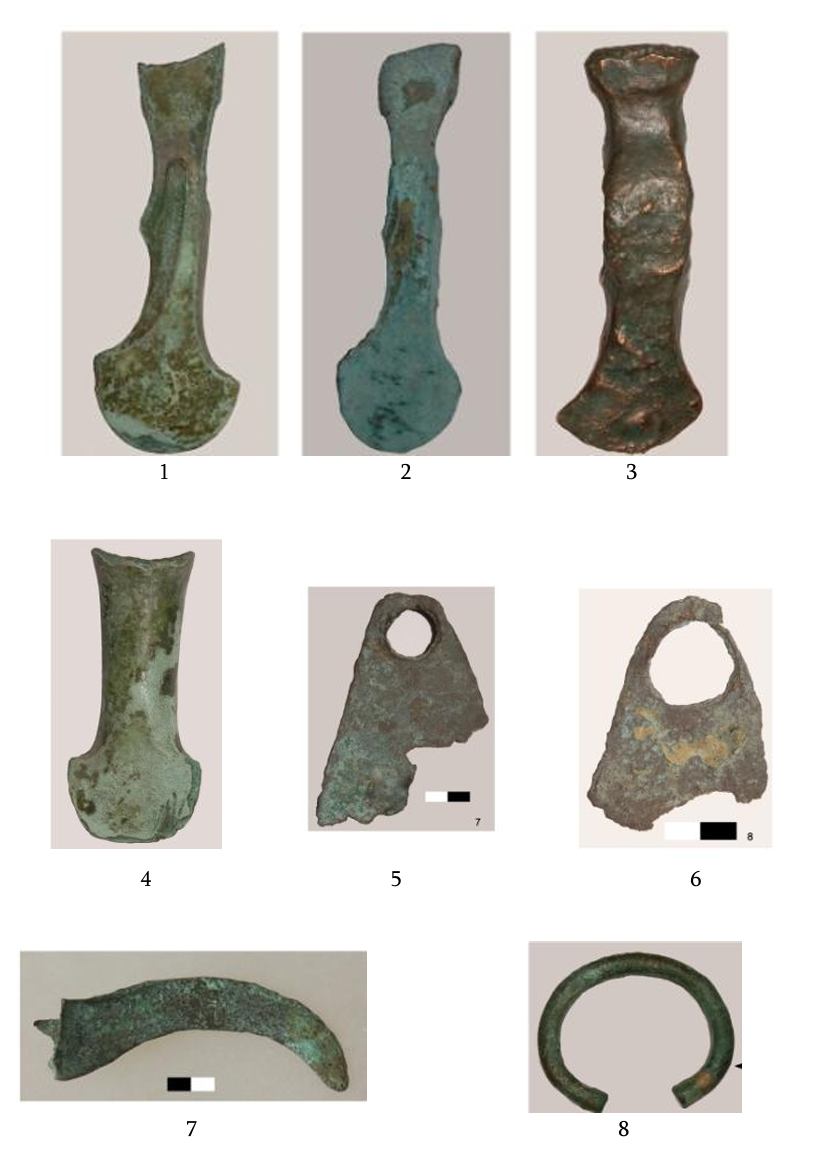
According to the researchers, the two axes belong to the first typological group of Colchian axes. This type is characterized by a high, pointed butt, a pointed-oval shaft hole, a hexagonal body, and an asymmetrical blade (Tab. I/1, 2).
The shaft-hole axe (Tab. I/3) represents a typological form whose early variants are associated with a small-scale, pre-Anatolian cultural sphere. It is suggested that its earliest development dates to the 12th-11th centuries BC, while its classical forms were established in southwestern Georgia and remained in use, with little morphological change, until the 7th century BC.
In scholarly literature, the vertical shaft-hole axe (Tab. I/4) is subject to differing interpretations. Some researchers regard it as a variant of Colchian axes, others draw parallels with flat axes, while a further group classifies it as belonging to the so-called “Celtic type.” There is no scholarly consensus regarding its function; it has been variously interpreted as a cutting implement, a simple agricultural tool used in ploughing, or as a weapon with a combat function.
Among the agricultural implements in the Chaisubani hoard, hoes with a broad working edge (Tabs. I/5-6) are particularly notable. These finds show the closest parallels with materials from Tsikhisdziri, Gantiadi, Bobokvati, and Vakijvari.
The hoard also includes a massive bronze ring decorated with a zoomorphic motif (Tab. I/8).
In scholarly literature, it is generally accepted that one of the centres of bronze production operated in the Chakvistskali River valley. The discovery of the Chaisubani hoard may also indicate the existence of a workshop in this area.
The Chaisubani hoard is housed in the LEPL Ajara Museum, the Khariton Akhvlediani Museum. ასსიპ ჭარის მუზეუმის – ხარიტონ ახვლედიანის სახელობის მუზეუმში.
Bibliography:
- 1. Kakhidze A., On the issue of the genesis of Hummer-Butted axes, - Proceedings of the Batumi Archaeological Museum, IV, Batumi, 2007:4-10. (pdf)
- 2. Ramishvili A., From the history of Colchian material culture, ed. “Soviet Ajara”, Batumi, 1974:13-14, Tab.VI
- Rusidze Sh., Expedition Reports in the Chakvi Gorge in 1954 - Manuscript Fund of the Khariton Akhvledini State Museum of Ajara, №486
- Rusidze Sh., Monuments of Material Culture of the Bronze Age, - Newspaper “Soviet Ajara”, 16 June, №118:4.
- Surmanidze N., Hoard of Chaisubani, - Proceedings of the Batumi Archaeological Museum, IV, Batumi, 2007:1-15. (pdf)
- Koridze D., For the History of Colchian Culture, “Science”, Tbilisi, 1965:21, Tab. XI/9-11, 13-15. (pdf)
- Koridze N., Caucasian Artistic Bronze, - Herald of the Khariton Akhvlediani Adjara Museum, III, Batumi, 2010:57-61.
Passport compiled by: Nargiz Surmanidze, Academic Doctor of History, LEPL Ajara Museum - Amiran Kakhidze Ajara Archaeological Museum, Researcher
